

Abstract
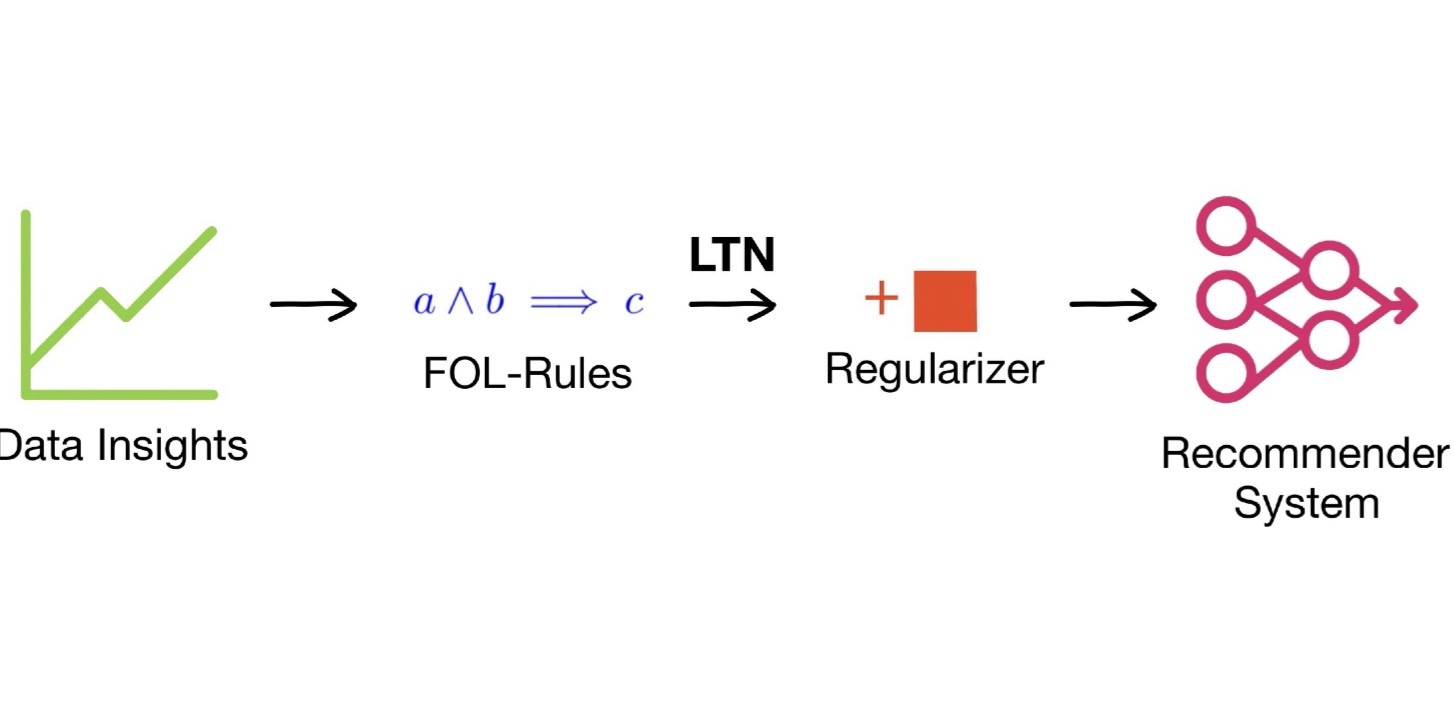
Music recommender systems shape how people discover music, yet persistent concerns have been raised regarding fairness and representation. Achieving fairness in recommender systems is challenging because conventional methods rely on rigid quantitative criteria, making it difficult to express nuanced or socially informed fairness goals. We explore the use of Logic Tensor Networks (LTNs) to incorporate nuanced fairness constraints into music recommender systems. LTNs enable the formulation of soft, differentiable constraints in a specific first-order logic, allowing fairness to be expressed through expert knowledge or data-driven insights. We make two main contributions. First, we extend an existing LTN-based recommender framework to the implicit-feedback setting. Second, we propose a procedure that uses the extended framework to integrate data-informed fairness regularization into matrix factorization (MF)-based music recommendation. We demonstrate effectiveness of the proposed procedure with a case study on country-level representation bias in music recommendation, where content from hegemonic markets (e.g., the U.S.) is often overrepresented while local music is underexposed. Our analysis reveals that this imbalance disproportionately affects users with high local mainstreaminess (those who prefer music popular within their own country) and low global mainstreaminess (those who prefer less globally popular music). Using LTNs, we design targeted, data-informed fairness constraints and show that our approach allows to mitigate these disparities while maintaining competitive recommendation quality.
Citation
Hannah
Eckert,
Oleg
Lesota,
Markus
Schedl
Extending Logic Tensor Networks to Implicit Feedback for Representation-Aware Music Recommendation
European Conference on Information Retrieval, 2026.
BibTeX
@inproceedings{Eckert2026LTN4ImplicitFeedback,
    title = {Extending Logic Tensor Networks to Implicit Feedback for Representation-Aware Music Recommendation},
    author = {Eckert, Hannah and Lesota, Oleg and Schedl, Markus},
    journal = {European Conference on Information Retrieval},
    booktitle = {European Conference on Information Retrieval},
    year = {2026}
}
Acknowledgements
Write acknowledgements for contributors.