

Abstract
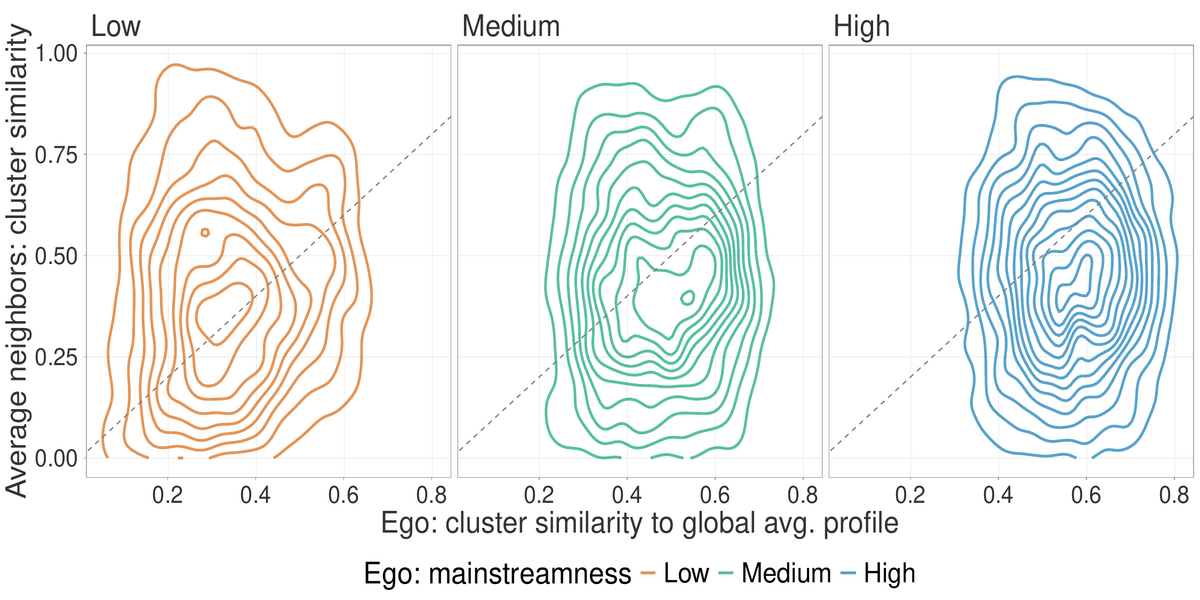
Many recommender systems implicitly assume homophily, i.e., that socially connected users have similar tastes. This assumption can be particularly problematic in group recommendation settings, where individuals' preferences can be non-homogeneous. Our study examines the homophily assumption in the music domain. Leveraging techniques from network analysis, we reconsider the definition of music similarity and analyze how users' taste similarity relates to social network structures across multiple levels. We then carry out recommendation experiments to evaluate how incorporating information on user--artist interactions, user--user connections, and artist--artist similarity, affects the quality of music recommendations. Our findings show that homophily operates differently across granularities, with a limited artist-level similarity among connected users, and a higher similarity at the artist-cluster level, and that different user groups benefit differently from the inclusion of social network and artist similarity data in recommendation quality. The results challenge homophily as a uniformly reliably proxy for inferring music preferences and suggest that a multi-granular, multi-layer notion of similarity better accounts for preference heterogeneity in group recommendations settings.
Citation
Marta
Moscati,
Xinwei Xu,
Markus
Schedl
Networked Tastes: Homophily for Music Recommendation
Workshops Proceedings of the 34th ACM International Conference on User Modeling, Adaptation and Personalization (UMAP 2026), Gothenburg, Sweden., 2026.
BibTeX
@inproceedings{Moscati2026group_homophily,
    title = {Networked Tastes: Homophily for Music Recommendation},
    author = {Moscati, Marta and Xu, Xinwei and Schedl, Markus},
    booktitle = {Workshops Proceedings of the 34th ACM International Conference on User Modeling, Adaptation and Personalization (UMAP 2026), Gothenburg, Sweden.},
    publisher = {CEUR-WS.org},
    year = {2026}
}